
AI-Assisted MBSE (AIM) teaches practical, repeatable workflows for using AI to dramatically accelerate SysML v2 modeling - without sacrificing rigor, structure, or traceability.
The course is organized around a concrete anchor example (a Scanning Electron Microscope) to demonstrate how models evolve from early concepts through architecture, simulation, implementation, and verification.
This page provides the detailed module-by-module course outline. The module details below are presented in an expandable format so you can quickly skim the flow or drill into each module.
A distinguishing feature of AIM is its emphasis on template-driven generation. Participants learn how to define reusable code and model generation templates that encode architectural decisions, modeling structure, and quality rules. AI is then used to populate those templates consistently and repeatedly.
This approach changes the economics of MBSE: engineers update intent or templates and regenerate artifacts, instead of manually reworking dozens of diagrams and specifications.
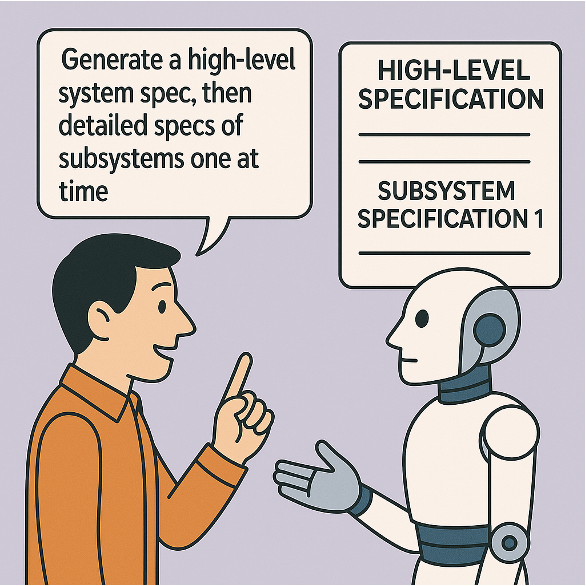
At the highest level, AIM generates a system specification first, followed by detailed specifications for subsystems - one subsystem at a time. This staged approach establishes system-level intent before detailed architectural elaboration begins.
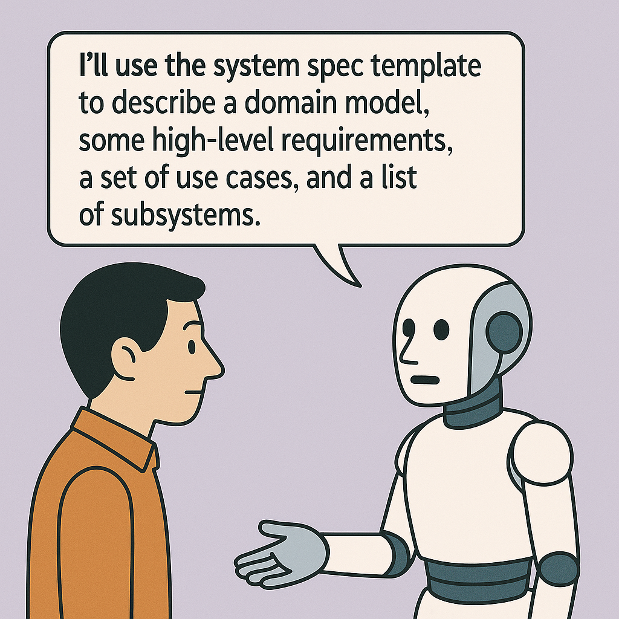
Engineers begin by defining a system specification template. AI is then used to populate that template to generate a domain model, a set of high-level requirements, a set of use cases, and an initial list of subsystems.
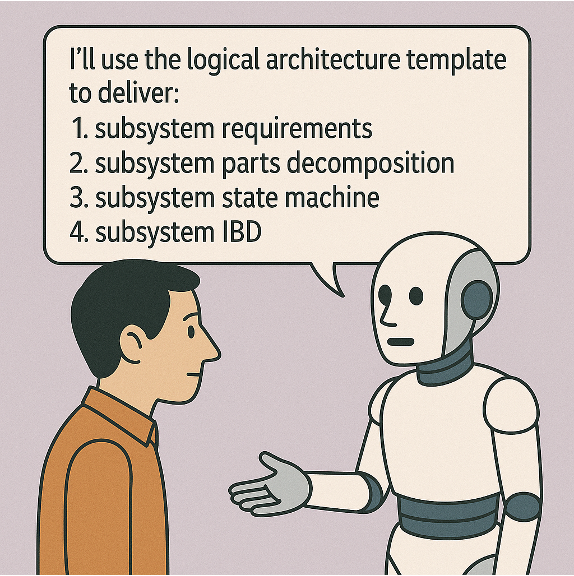
Once the system structure is in place, engineers apply logical architecture templates to each subsystem. These templates generate subsystem requirements, parts decomposition, subsystem state machines, and subsystem internal block diagrams. The result is dramatic acceleration: update intent or templates and regenerate artifacts, instead of manually reworking dozens of diagrams and specifications.
Click a module to expand the details.
